Matching Game Kids Worksheets
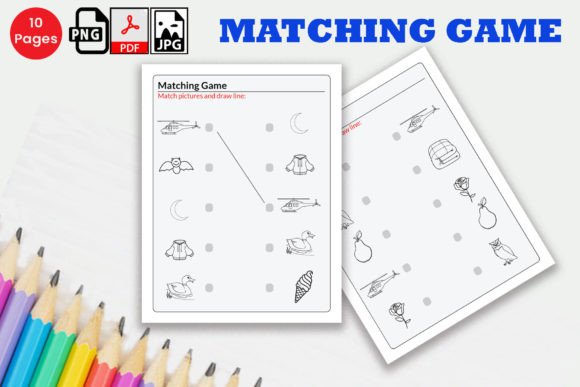
Matching Game Kids Worksheets are more than just printable pages—they’re flexible, classroom-ready tools designed to build foundational cognitive skills through purposeful play. Each worksheet invites children to connect ideas visually and logically: pairing letters with pictures, objects with shadows, numbers with quantities, or words with corresponding images. What makes them especially valuable is their intentional simplicity—no distractions, no clutter, just clear visual relationships that support early learning without overwhelming young minds.
These sheets aren’t built for passive completion. They’re engineered for interaction: drawing lines, circling matches, tracing paths, or even cutting and pasting. That physical engagement strengthens fine motor control while reinforcing recognition, memory, and reasoning—all essential for pre-K, kindergarten, and early 1st grade development. And because they’re grounded in evidence-based early learning principles—like visual discrimination, one-to-one correspondence, and symbolic association—they work whether used at home, in a Montessori setting, during homeschool lessons, or as part of a structured intervention plan.
Creative Applications Beyond the Classroom
Educators and creators alike find unexpected versatility in Matching Game Kids Worksheets. A preschool teacher might use them as morning warm-ups, laminating a set for repeated use with dry-erase markers. A curriculum designer could integrate them into themed units—pairing animal silhouettes with names for a science module, or matching seasonal items (mittens, sun, leaves, snowflakes) to reinforce calendar concepts. An illustrator or indie publisher might adapt the clean layouts as templates for custom activity books, adding original characters or culturally responsive imagery while preserving the core matching structure.
For Amazon KDP publishers, these worksheets offer a proven, low-risk entry point. With 10 PDF, 10 JPG, and 10 PNG pages, all no-bleed, KDP-tested, and print-ready, creators can quickly compile a cohesive workbook—say, “Spring Matching & Tracing Fun” or “Alphabet Match + First Words”—without designing from scratch. The consistent format ensures brand cohesion across product lines, and the inclusion of multiple file types supports varied production needs: PDFs for direct printing, PNGs for digital overlays or app integration, JPGs for social media previews or blog demos.
How Different Users Adapt Them Effectively
Early childhood educators often layer matching tasks with oral language practice—asking students to name each item before drawing the line, or describing *why* two things go together (“A bee matches a flower because bees visit flowers”). This turns a simple visual task into a multimodal learning moment.
Homeschooling parents appreciate how easily these sheets integrate into daily rhythms. One parent uses them alongside sensory bins: after matching ocean animals on paper, her child explores real shells and toy fish in a blue-tinted rice bin. Another rotates them weekly with tracing worksheets—starting with letter matching on Monday, then moving to image matching on Wednesday, and finishing with coloring extensions on Friday. The predictability builds confidence; the variation sustains interest.
Freelance designers and content creators leverage the clean, scalable files to customize for niche audiences. A bilingual educator added Spanish labels to the image-matching pages for dual-language learners. A special education therapist modified the line-drawing prompts into thicker, high-contrast paths for students with visual processing needs. Because the base design is uncluttered and well-spaced, adaptations stay functional—not forced.
Practical Tips for Maximum Clarity and Impact
- Keep alignment intentional. Ensure matched pairs appear on the same page—never split across columns or pages—to reduce cognitive load and support independent use.
- Use consistent visual hierarchy. Place prompts (e.g., “Draw a line to match”) at the top in readable font; keep illustrations simple, high-contrast, and age-appropriate in scale and detail.
- Design for accessibility from the start. Avoid relying solely on color to indicate matches—add shape cues or texture variations where possible. Leave generous white space around items to prevent crowding.
- Test for real-world use. Print a sample on standard 8.5" x 11" paper, run it through a home printer, and check margins and clarity—especially if targeting KDP, where bleed and trim matter.
What sets these Matching Game Kids Worksheets apart isn’t novelty—it’s reliability. They don’t chase trends; they serve enduring developmental needs. Whether you’re building a full learning system, launching your first KDP workbook, or supporting a child who learns best through hands-on connection, these sheets deliver focused, adaptable utility. You’ll get ten thoughtfully composed pages—not filler, not repetition, but ten distinct opportunities to teach, observe, and respond.
And because learning evolves, so should your resources. If you value clean design, pedagogical intention, and ready-to-deploy quality, consider following for updates. New releases—like coordinated tracing worksheets, alphabet tracing workbooks, or themed matching and coloring sheets—build naturally on this foundation. Each one respects the learner’s pace, the educator’s time, and the creator’s need for consistency without compromise.
No fluff. No overpromising. Just tools that work—clearly, quietly, and well.