200 Cute Simple Flower Coloring Pages: A Strategic Creative Asset for Modern Digital Publishers
In today’s rapidly evolving digital content ecosystem, efficiency, scalability, and aesthetic coherence are no longer optional—they’re foundational. For professionals building print-on-demand (POD) businesses, launching KDP coloring book series, or developing branded creative resources for educators and therapists, 200 Cute Simple Flower Coloring Pages represents more than a collection of line art—it’s a purpose-built, production-ready asset engineered for speed, versatility, and market alignment.
What Exactly Is 200 Cute Simple Flower Coloring Pages?
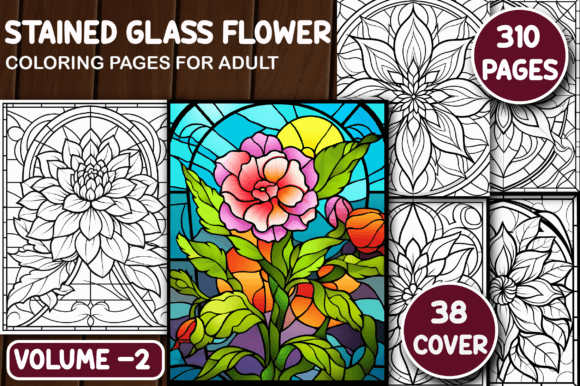
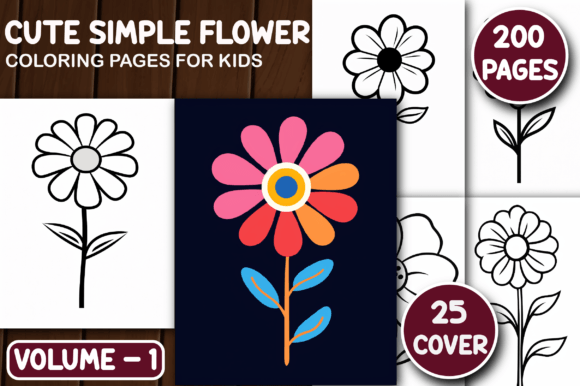
200 Cute Simple Flower Coloring Pages is a professionally curated digital printable coloring book bundle designed specifically for creators who prioritize both quality and workflow efficiency. Volume 1 contains exactly 200 original, hand-refined floral illustrations—each intentionally simplified for accessibility while retaining visual charm and botanical recognizability. These aren’t generic clipart florals; they’re clean, balanced compositions optimized for color application, fine motor development, and consistent printing performance.
The bundle includes two complementary file formats: 200 print-ready PDF pages (A4 / 8.5×11″) and 200 high-resolution PNG files at 300 dpi, ensuring compatibility across platforms—from KDP uploads to Canva-based marketing assets or classroom handouts. Complementing the interior pages are 25 premium book cover designs, delivered as scalable PNGs (also 300 dpi), enabling rapid A/B testing, niche targeting (e.g., “for kids,” “mindful adults,” “botanical therapy”), and brand-consistent series expansion.
Importantly, this is an AI-generated foundation refined in Adobe Illustrator. That distinction matters: raw AI output often lacks structural precision for coloring use—overlapping lines, inconsistent stroke weights, or unintended closures that frustrate users. Here, each floral motif has been manually adjusted for clarity, symmetry, and coloring integrity. The result? A set that performs reliably—not just aesthetically, but functionally—across real-world applications.
Why This Bundle Fits Today’s Creative & Commercial Landscape
The rise of 200 Cute Simple Flower Coloring Pages reflects broader shifts across three intersecting domains: publishing infrastructure, consumer expectations, and creative labor economics.
1. The Acceleration of Niche Publishing Cycles
Amazon KDP, Etsy, and Gumroad have lowered barriers to entry—but raised expectations for volume, consistency, and speed. Top-performing coloring book publishers no longer release one title per quarter; they deploy themed bundles (e.g., “Spring Botanicals,” “Floral Mandalas for Kids”) on tight cadences. 200 Cute Simple Flower Coloring Pages directly supports this model: it delivers a full-volume interior in a single download, eliminating weeks of illustration sourcing, vector cleanup, and layout iteration. For freelancers managing multiple client portfolios—or solopreneurs scaling a POD brand—it compresses time-to-market without sacrificing design cohesion.
2. The Demand for Developmentally Intelligent Design
“Cute” and “simple” aren’t stylistic afterthoughts—they’re pedagogical choices. Research in early childhood education confirms that clear outlines, moderate detail density, and recognizable natural forms support visual discrimination, pencil control, and sustained attention in children aged 4–9. Each page in this bundle was calibrated with those benchmarks in mind: petals are distinct but not fragmented; stems are continuous; negative space invites confident color placement. It’s not minimalism for its own sake—it’s intentional scaffolding for skill-building.
This aligns precisely with the growing emphasis on purpose-driven creativity—where coloring books serve dual roles: leisure and learning. Educators integrate them into sensory regulation routines; occupational therapists use them for fine motor assessment; homeschoolers treat them as cross-curricular tools (science + art + emotional literacy). 200 Cute Simple Flower Coloring Pages meets that expanded brief—not by adding text or instructions, but by embedding developmental logic into every line.
3. The Shift Toward Hybrid Production Workflows
Modern creators rarely rely on a single toolchain. They combine AI ideation, vector refinement, layout automation, and platform-specific formatting. This bundle embraces that reality. The inclusion of both PDF and PNG files acknowledges divergent needs: PDFs ensure typographic fidelity and KDP compliance; PNGs enable dynamic resizing, layering in design software, and integration into interactive PDFs or web-based coloring apps. The 25 cover options further reduce dependency on external designers—allowing marketers to test messaging (“Calm Flowers,” “Joyful Blooms,” “First Flower Book”) without new commissions.
That hybrid approach mirrors industry-wide movement toward modular creative assets: reusable, interoperable components that accelerate iteration while preserving brand voice. It’s the same principle behind design systems in UI/UX or template libraries in video editing—only applied to analog-adjacent digital products.
Practical Integration: How Professionals Are Using It Now
Real-world adoption reveals nuanced utility beyond basic printing:
- KDP Publishers are using the 200-page interior as a base for multiple sub-branded titles—e.g., adding custom title pages, age-targeted introductions, and themed backmatter (flower facts, coloring tips) before uploading separate ASINs. One publisher reported launching 7 distinct listings in under 10 days using this single bundle as their core asset.
- Educational Freelancers embed individual PNGs into Google Slides lesson decks, then export as printable worksheets—leveraging the 300 dpi resolution for crisp projection and handout quality alike.
- Therapy Practitioners select specific pages based on therapeutic goals: symmetrical blossoms for bilateral coordination practice; clustered blooms for visual scanning exercises; open-center flowers for guided mindfulness prompts.
- Marketing Teams repurpose cover designs as social media banners, email headers, or limited-edition digital gift cards—extending the bundle’s ROI far beyond physical printing.
Addressing Real-World Considerations Transparently
No digital asset is frictionless—and transparency builds trust. As noted in the product details, these illustrations originate from AI generation, then undergo manual vector refinement in Adobe Illustrator. While the final output meets professional printing standards, minor inconsistencies may appear—such as a stray anchor point or subtle stroke variation. That’s not a flaw in execution; it’s an honest reflection of the hybrid production pipeline. For most users, these nuances are imperceptible when printed. For advanced designers, they represent editable touchpoints—not roadblocks.
This level of disclosure signals maturity. It avoids overpromising while affirming value: you’re not buying raw AI output—you’re acquiring a production-validated starting point, stress-tested for real usage contexts.
Looking Ahead: Where Simplicity Meets Strategy
The enduring appeal of floral motifs—especially in simplified, approachable forms—stems from their cultural resonance and functional flexibility. Flowers signify growth, calm, renewal, and care—values increasingly central to wellness branding, educational philosophy, and mindful consumerism. 200 Cute Simple Flower Coloring Pages taps into that resonance deliberately, offering not just images, but a ready-made vocabulary for communicating those ideas visually.
For professionals navigating saturated markets, differentiation lies less in novelty and more in executional rigor: reliable files, thoughtful constraints, and contextual awareness. This bundle delivers all three—not as features, but as embedded discipline. It assumes you understand your audience, your platform, and your goals—and gives you the calibrated tools to act decisively.
In an era where attention is scarce and iteration cycles are short, 200 Cute Simple Flower Coloring Pages doesn’t ask you to start from scratch. It invites you to build with intention—on a foundation that’s already aligned with what creators need, what platforms require, and what users truly engage with.