450 Farm Animals Coloring Pages for Kids
For creators, educators, and small publishers building print-on-demand or digital activity resources, 450 Farm Animals Coloring Pages for Kids represents a substantial, production-ready asset—particularly when evaluated for consistency, technical readiness, and audience alignment. Unlike fragmented collections or low-resolution clipart bundles, this set delivers a cohesive, high-fidelity interior package designed for real-world use across multiple platforms and formats.
What It Is—and Why It Stands Out
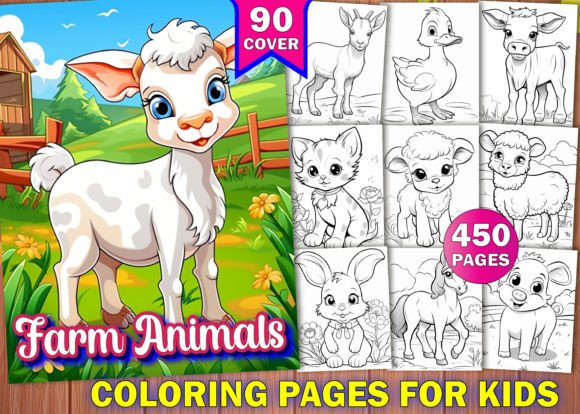
This resource is not a single coloring book but a scalable, modular interior library: 450 original black-and-white line art illustrations of farm animals, organized into two volumes (with Volume 3 referenced as part of the broader offering). It includes 90 additional cover-ready images—ideal for designing distinct book variants without outsourcing design work. All pages are sized to standard US letter dimensions (8.5” x 11”), rendered at 300 DPI, and delivered in three complementary file types: PDF (print-optimized, single-page layout), JPG (raster, high-res, universally compatible), and PNG (transparent background support where applicable). Notably, SVG and EPS files are also included—valuable for vector-based editing, scaling, or integration into Adobe Illustrator or Cricut workflows.
Technical Quality and Production Readiness
The 300 DPI resolution ensures sharp, clean lines when printed on standard home or commercial printers—no pixelation, no thin-line dropout, and minimal ink bleed on typical 60–100 lb paper stocks. Each illustration maintains consistent line weight (0.5–0.7 pt), appropriate negative space, and age-appropriate detail: simple enough for early elementary users (ages 4–8), yet engaging for older children who enjoy texture cues like fleece patterns on sheep or feather groupings on chickens. The black-and-white rendering avoids grayscale noise or anti-aliasing artifacts—critical for reliable toner-based printing and KDP thumbnail clarity.
File organization follows practical publishing logic: JPG and PNG folders are numerically labeled (001–450), enabling batch import into InDesign or Canva; the PDF is flattened and non-editable—ideal for immediate upload to Amazon KDP or Etsy as a ready-to-print interior. No fonts, watermarks, or embedded metadata interfere with reuse. That level of technical discipline reduces prepress time significantly—especially compared to free image repositories requiring manual cleanup, resizing, or copyright verification.
Use Cases Beyond Standard Coloring Books
While marketed for kids’ coloring books, the utility extends further. Educators use individual pages as printable handouts for life science units—labeling animal anatomy, matching habitats, or sequencing life cycles. Homeschool co-ops integrate them into unit studies on agriculture, sustainability, or rural communities. Therapists and occupational therapists apply select pages for fine motor skill development, given the balanced mix of large-outline animals (e.g., cows, horses) and finer-detail subjects (geese, roosters, rabbits).
For digital product creators, the inclusion of SVG and EPS files supports derivative uses: converting outlines into cut files for vinyl or laser-cutting projects, adapting illustrations into animated GIFs for social media, or importing into Procreate for custom brush sets. The PNG transparency option allows layering over textured backgrounds or photo composites—useful for bloggers creating themed Pinterest pins or Instagram carousels about farm education.
Audience Fit and Realistic Limitations
This collection serves best those who need volume, uniformity, and technical reliability—not novelty or artistic experimentation. It’s well-suited for Amazon KDP authors launching multiple titles under related niches (e.g., “Cute Farm Animal Coloring Book For Kids,” “Farm Animals Coloring Pages for Toddlers,” “Educational Farm Animal Tracing & Coloring Workbook”). Its strength lies in repeatability: you can produce 3–5 distinct SKUs from one purchase, varying only covers, titles, and minor front/back matter.
That said, it does not include instructional text, answer keys, or pedagogical scaffolding—so standalone educational use requires supplemental content creation. The animal selection leans toward familiar Western farm species (cows, pigs, sheep, chickens, horses, goats, ducks, geese, donkeys) with limited representation of less common livestock like alpacas, llamas, or turkeys. There are no anthropomorphized characters or narrative scenes—just clear, isolated animal portraits. That’s intentional and beneficial for clarity, but may not suit creators seeking story-driven or emotionally expressive themes.
Workflow Integration and Long-Term Value
In practice, users report cutting interior production time by 60–70% versus sourcing and editing individual assets. One small publisher noted using the JPG files directly in Canva to generate 12-page mini-books for local farm festivals—customizing each with venue-specific headers and sponsor logos in under an hour. Another educator built a rotating monthly animal-themed bulletin board using the PNGs layered over burlap-textured backgrounds, reusing the same files across three school years with no degradation in quality.
Because all files are owned outright (no subscription or attribution requirements), the investment scales cleanly: there’s no recurring cost, licensing ambiguity, or platform lock-in. Updates or expansions—like adding seasonal variants (e.g., “Spring Farm Animals” or “Harvest Time Farm Friends”)—can be built incrementally using the existing style guide embedded in the line work.
Who Benefits Most—and When
- Amazon KDP Publishers: Those launching multiple low-content books benefit from the volume and formatting consistency—reducing cover-to-interior mismatch risk and supporting A/B testing of titles and thumbnails.
- Educators & Homeschoolers: Users needing reproducible, copyright-safe visuals for lesson plans, flashcards, or classroom displays value the ready-to-print format and absence of usage restrictions.
- Digital Product Creators: Designers building Canva templates, Procreate brushes, or SVG craft bundles gain flexibility from the multi-format delivery and clean vector paths.
- Small Print Shops & Local Businesses: Farms, agritourism venues, or rural libraries use individual pages for event handouts, scavenger hunts, or gift shop merchandise—without needing graphic design expertise.
It’s less ideal for illustrators seeking stylistic inspiration (the aesthetic is functional rather than distinctive) or for apps requiring animated sprites or interactive layers. But as a foundational, production-grade interior asset—especially for creators prioritizing speed, compliance, and scalability—450 Farm Animals Coloring Pages for Kids delivers measurable, repeatable utility. Its value compounds not in novelty, but in reliability: 450 pages that print clearly, import smoothly, and serve diverse audiences without revision or remediation.