230 Chicken Coloring Pages for Kids KDP
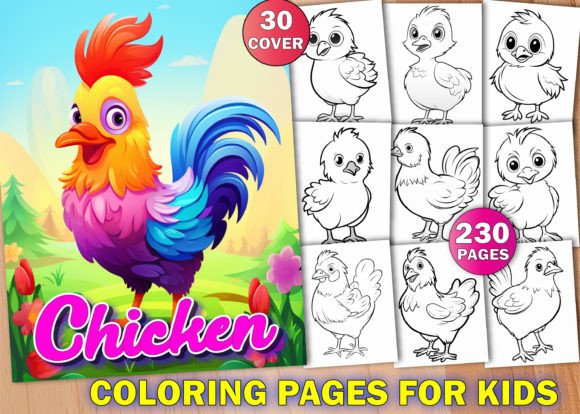
If you're building a kids’ activity brand on Amazon KDP—or scaling a creative business that serves educators, parents, and small publishers—you need assets that are both production-ready and emotionally resonant. 230 Chicken Coloring Pages for Kids KDP isn’t just another bundle of line art. It’s a thoughtfully assembled interior download built for real-world use: 230 high-resolution, black-and-white coloring pages designed specifically for children aged 3–10, each crafted with clear outlines, balanced negative space, and age-appropriate detail.
The collection carries a warm, approachable personality—friendly but not cutesy, structured but not rigid. Chickens appear in playful poses: pecking, nesting, strutting, roosting, even wearing tiny hats or holding eggs. Some pages feature simple farm scenes; others spotlight solo birds with expressive eyes and gentle curves. There’s no visual fatigue here—no over-rendered complexity or inconsistent line weights. Every image breathes, invites color, and supports fine motor development. That consistency across 230 pages isn’t accidental. It reflects intentional design discipline—something that matters deeply when you’re assembling a cohesive book series like 230 Chicken Coloring Pages for Kids Volume – 3.
Why This Collection Fits Real Publishing Workflows
KDP creators know the pain points: last-minute formatting hiccups, mismatched resolutions, or files that print faintly or pixelate at scale. This bundle eliminates those risks. All 230 images come in three formats—PDF (print-ready, single-page layout), JPG, and PNG—each at true 300 DPI and precisely 8.5” x 11”. That means no resizing, no interpolation, no guessing whether your interior will hold up on matte or glossy paper. The PDF alone saves hours: open it, drop it into your KDP manuscript template, and go. No layer flattening, no background removal, no color correction needed.
And because it includes 30 bonus coloring images for your book cover, you’re not scrambling to commission custom art or license generic stock. Those cover-ready images maintain the same stylistic voice—clean lines, friendly proportions, strong silhouette—so your cover and interior feel like parts of one unified product, not a patchwork.
Design Flexibility Beyond the Page
While built for coloring books, these chicken illustrations function surprisingly well across broader creative applications. Teachers use individual pages as printable classroom rewards or themed lesson supplements (life cycles, farm units, spring activities). Bloggers embed them in seasonal roundups (“10 Free Spring-Themed Printables”) with attribution-friendly usage terms. Crafters repurpose the PNGs—transparent backgrounds included—for vinyl cutting, embroidery patterns, or sublimation mugs. Even marketers building email lead magnets find value: “Download our free chicken-themed activity pack” converts well because the visuals feel handmade, not algorithmically generated.
That versatility stems from how the artwork balances simplicity and character. It’s not minimalist to the point of sterility, nor is it so detailed it overwhelms younger colorists. Lines have subtle variation—slightly thicker on outer contours, gently tapering on wings or beaks—which adds dimension without sacrificing clarity. That nuance translates directly to better engagement: kids stay focused longer, adults perceive higher perceived value, and reviewers notice the care behind the craft.
Practical Integration Tips for Creators
Before adding 230 Chicken Coloring Pages for Kids KDP to your next project, ask two questions: Does this match my audience’s developmental sweet spot? and Will it support my brand’s visual rhythm? For early elementary audiences, prioritize pages with larger shapes and fewer internal details—like the “chick in an egg” or “rooster with big comb” variations. For older kids or mixed-age collections, lean into scenes with light environmental context: a chicken coop, a basket of eggs, or chickens interacting with butterflies or flowers.
When pairing with typography, avoid fonts that compete for attention. A clean sans serif (like Montserrat or Open Sans) works beautifully for titles and instructions—its neutrality lets the chicken art shine. If you’re designing a companion activity guide or teacher’s notes, consider a gentle handwritten font for callouts or speech bubbles—but only where it enhances readability, not distracts. Never force contrast for the sake of trendiness.
Licensing is straightforward: commercial use is permitted, including resale on KDP, Etsy, or your own website. No attribution required, though crediting the source builds goodwill if you’re sharing previews on social media or design forums. Just remember—while the PNGs give you flexibility for digital overlays or layered designs, the JPGs are ideal for fast uploads to print-on-demand platforms where file size matters.
Volume – 3: Continuity With Intentional Evolution
230 Chicken Coloring Pages for Kids Volume – 3 doesn’t repeat earlier volumes. It expands the world. You’ll find new poses—chickens mid-jump, chickens peeking from behind fences, chickens wearing seasonal accessories (a tiny scarf for winter, sun hat for summer). Background elements are slightly more developed than in Volume 1, but still minimal enough to keep coloring accessible. That progression reflects how seasoned creators think: not “more of the same,” but “what’s next that serves the audience deeper?”
This kind of thoughtful iteration builds reader loyalty. A child who loved Volume 1 will recognize the style in Volume 3—but also discover fresh surprises. For publishers, it means less marketing lift to retain buyers across releases. For designers bundling multiple volumes into themed packages (“Farm Friends Mega Bundle”), the consistency across files makes assembly frictionless: same dimensions, same resolution, same naming convention.
Real talk: if you’ve ever spent $40+ on a single royalty-free illustration pack only to find half the files unusable at print size—or worse, discovered hidden usage limits after uploading to KDP—then the reliability baked into 230 Chicken Coloring Pages for Kids KDP is its quiet superpower. It’s not flashy. It doesn’t promise viral growth. It delivers exactly what it says, cleanly, consistently, and without caveats.
So whether you’re launching your first KDP coloring book, expanding an existing series, or sourcing design assets for a client’s educational app, this collection earns its place in your toolkit—not as filler, but as functional, empathetic, and quietly professional design infrastructure.