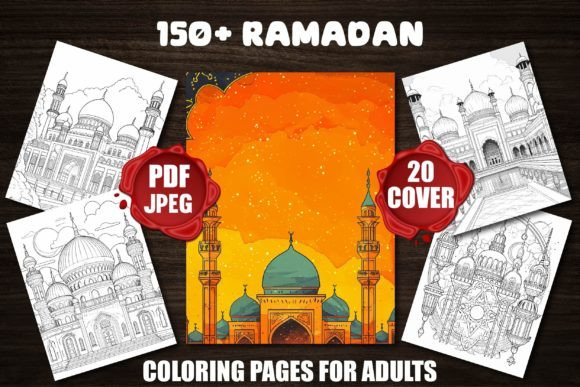
Ramadan Coloring Pages
Ramadan Coloring Pages is a purpose-built digital resource designed for adults seeking a quiet, intentional way to engage with the spiritual and cultural rhythms of Ramadan. Unlike generic coloring books, this collection centers specifically on motifs, symbols, and scenes tied to Islamic tradition—crescent moons, lanterns (fanous), prayer beads, mosque silhouettes, Arabic calligraphy of common duas and surah openings, and stylized depictions of iftar gatherings and taraweeh prayers. It’s not marketed as religious instruction, but rather as a tactile, visual companion to reflection—something that fits naturally into a morning routine, a post-work decompression window, or even a shared creative moment during family time.
What Sets These Pages Apart in Practice
The value lies less in novelty and more in execution consistency and contextual relevance. With over 150 JPEG files included—all delivered in A4 (8.5×11″) size at 300 DPI—the set avoids the pixelation or scaling issues common in lower-resolution downloads. Each illustration was drawn with line weight variation in mind: thicker outlines hold up well when printed on standard office paper, while finer interior details remain legible without bleeding or filling in unintentionally. That matters for users who print repeatedly across different printers (e.g., home inkjet vs. office laser) or who plan to frame finished pieces.
The PDF delivery format adds reliability: no software dependencies, no cloud logins, no expiring links. Once downloaded, the files are fully portable—usable offline, compatible with most devices, and easily integrated into existing workflows. For educators or community coordinators, that means pulling a single page for a virtual iftar activity without needing to convert or reformat. For self-publishers using Kindle Direct Publishing (KDP), the high-DPI JPEGs serve directly as interior assets, while the 20 included PNG cover files (also at 300 DPI) provide clean, transparent-background options for branding and thumbnail visibility.
Usability and Real-World Flexibility
This isn’t a “one-size-fits-all” product—and it doesn’t try to be. The absence of pre-colored samples or guided instructions signals its intended audience: adults already familiar with coloring as a tool for focus or stress modulation. There’s no forced narrative or prescribed sequence. Users can jump between a geometric arabesque pattern and a gentle scene of dates and water beside a prayer mat based on mood, time available, or even physical energy level.
That flexibility extends to application. Freelance designers have used individual pages as base layers for social media graphics—overlaying subtle textures or soft gradients in editing tools like Photoshop or Affinity Designer. Bloggers covering mindful living or seasonal wellness have embedded uncolored versions into posts as interactive elements, inviting readers to download and color along. Small business owners running halal-certified gift shops have printed select designs on greeting cards or packaging inserts—leveraging the cultural resonance without relying on stock imagery.
Quality Consistency Across the Collection
Reviewing all 150+ images reveals deliberate pacing in complexity. Early pages feature moderate detail—ideal for those easing back into coloring after a break or managing fatigue. Mid-range illustrations introduce layered symmetry (e.g., repeating star-and-cross patterns inspired by zellige tilework), while later pages incorporate narrative subtlety: a child holding a lantern under a starry sky, hands raised in dua with delicate henna-inspired borders. None rely on photorealism; instead, they balance recognizability with interpretive space—leaving room for personal expression without demanding technical skill.
Color theory isn’t enforced, but the compositions support thoughtful palette choices. Negative space is intentionally generous—not empty, but purposeful—allowing for washes, blending, or selective emphasis. This makes the pages equally effective with colored pencils, fine liners, watercolor pencils, or even light marker work (though bleed-through should still be tested on your preferred paper).
Audience Fit: Who Benefits Most—and When
Professionals in high-cognitive-load roles—software developers, project managers, academic researchers—often cite these pages as low-barrier transitions between work modes. One educator described using a five-minute coloring session before leading virtual Quran study circles to shift mental gear from administrative tasks to presence. Entrepreneurs preparing Ramadan marketing campaigns have reported clearer ideation after sketching over printed pages during early-morning planning blocks.
It also serves niche use cases well. Therapists specializing in culturally responsive care sometimes integrate selected pages into sessions with Muslim clients exploring identity, ritual continuity, or intergenerational connection. Similarly, non-Muslim educators developing inclusive curriculum materials have found the imagery respectful, accurate, and free of stereotyping—especially compared to widely available clipart alternatives.
That said, limitations exist. The collection assumes familiarity with Ramadan’s visual language. Someone entirely new to Islamic traditions may not recognize the significance of certain motifs without external context. There are no explanatory captions, glossaries, or historical notes included—by design, not oversight. This keeps the file lightweight and focused, but means it functions best as a complementary tool rather than a standalone educational resource.
Long-Term Utility and Integration
Because the files are downloadable and license-free for personal and small-business use (with clear attribution expectations for commercial redistribution), they avoid subscription fatigue or platform lock-in. You’re not paying for access—you’re acquiring assets. That supports sustainability: a user can revisit the same page months later, apply a different medium, or reinterpret it alongside evolving life circumstances—new parenthood, relocation, recovery from illness—without needing new purchases.
For creators building digital products, the package provides immediate raw material. A marketer launching an email series on mindful observance could pull three themed pages—one for intention-setting, one for gratitude reflection, one for community—then add short journal prompts. A content creator producing YouTube shorts on “Ramadan routines” might animate a time-lapse of coloring a fanous page while voiceover discusses pacing and presence.
Ultimately, Ramadan Coloring Pages succeeds not by trying to do everything, but by doing one thing well: offering consistent, culturally grounded, technically sound visual material that meets adults where they are—whether that’s seeking calm, expressing devotion quietly, designing thoughtfully, or simply honoring a season with attention and care.