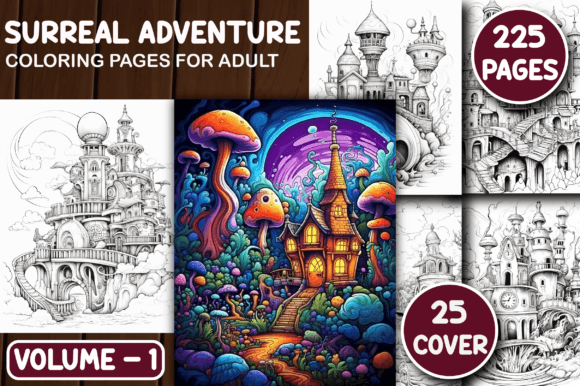
225 Surreal Adventure Coloring Pages
Imagine opening a coloring book where logic bends, landscapes breathe, and faces dissolve into constellations—then reassemble as mountains, clocks, or cascading vines. That’s the quiet power of 225 Surreal Adventure Coloring Pages: not just line art, but a curated toolkit for adult focus, creative recalibration, and tangible output. This isn’t filler content disguised as inspiration. It’s 225 ready-to-print, A4-optimized pages designed with intention—each one built to support real-world use, whether you’re unwinding after work, prototyping visual ideas, or building a KDP catalog.
A Resource Built for Action, Not Just Aesthetics
What sets this collection apart isn’t just its surreal theme—it’s how it bridges imagination and execution. Every page is delivered in two formats: print-ready PDF (8.5×11″ / A4) and high-resolution PNG (300 dpi), so you can drop them directly into design software, layout tools, or print workflows without resizing guesswork. The 225 pages include layered compositions—floating islands tethered by staircases, botanical figures with architectural limbs, dreamlike cityscapes folded inside human profiles—all generated with AI, then refined manually in Adobe Illustrator. That post-generation polish means cleaner lines, intentional negative space, and consistent stroke weight—critical for crisp printing and confident coloring.
The inclusion of 25 premium book cover PNGs (also 300 dpi) removes a common bottleneck. You don’t need design skills to launch a cohesive product—you get covers that match the interior tone: moody, intricate, and quietly mysterious. Resize freely. Pair with your own title font. Test variations on Amazon KDP preview. Launch faster, iterate smarter.
Creative Applications Beyond the Page
This bundle thrives when treated as raw material—not just a passive coloring experience. Here’s how different users are applying it:
- Freelance designers use individual pages as base layers for client mood boards—overlaying brand colors, typography, or texture maps to explore visual identity directions quickly.
- Educators and therapists select specific pages to prompt narrative writing, emotion mapping, or cognitive flexibility exercises—e.g., “Describe what happens when the clock-face tree blooms” or “Trace the path from the door in her ear to the sky above.”
- KDP publishers split the collection into themed sub-bundles (e.g., “Surreal Faces,” “Architectural Dreams,” “Botanical Portals”)—each with its own cover—creating multiple low-effort, high-perceived-value listings.
- Content creators animate single frames using simple keyframing tools, turning static surreal scenes into 5–10 second Instagram Reels or TikTok transitions that stop scrollers mid-feed.
- Hobbyists and journalers print select pages at 70% scale, glue them into mixed-media spreads, and annotate with ink, watercolor washes, or collaged text—transforming coloring into tactile reflection.
Practical Tips for Consistent, Audience-Friendly Results
Because these are AI-assisted designs, subtle inconsistencies may appear—like minor line gaps, overlapping strokes, or asymmetrical details. That’s not a flaw; it’s an invitation to engage more deliberately. Use those moments as checkpoints:
- Zoom in before printing a test page—spot-check areas where fine detail meets dense linework.
- In Illustrator or Affinity Designer, use the “Live Paint Bucket” tool to quickly isolate and recolor sections if prepping for digital sharing.
- When assembling a KDP book, group pages by complexity: start with lower-density scenes (more breathing room), build toward intricate ones (higher engagement), and end with a strong, balanced composition—this creates natural pacing.
- For social sharing, pair each colored page with one sentence about *why* you chose it—not just “I love this!” but “This shape reminded me of my grandmother’s garden gate, so I used only blues and rust.” Specificity builds connection.
Who Benefits—and How They Adapt It
You don’t need to be an artist to benefit from 225 Surreal Adventure Coloring Pages. You do need clarity about your goal—and this collection supports multiple paths without forcing one style:
Small business owners embed printable pages into email sign-up bonuses—“Get 5 free surreal pages when you join our creative toolkit list.” It’s low-cost, high-perceived value, and positions your brand as resourceful, not salesy.
Bloggers and educators license individual pages (with proper attribution) for use in paid workshops—e.g., “Surreal Story Sparks” writing sprints—or embed them in Notion templates as visual prompts for brainstorming sessions.
Marketers repurpose motifs across channels: a floating island becomes a LinkedIn banner; a clock-face vine becomes a slide background for a time-management webinar; a mirrored face motif becomes the visual anchor for a personal branding guide.
The key is restraint. Don’t try to use all 225 at once. Start with 10 that resonate with your current project or audience need. Print them. Color one. Scan it. Ask: Does this support the message? Does it feel distinct from generic stock? If yes, scale intentionally.
Realistic Expectations, Real Creative Leverage
This is not “magic art”—it’s well-crafted, practical infrastructure. The AI foundation accelerates ideation; the Illustrator refinement ensures usability. Some pages may require light cleanup before commercial use—but that’s standard practice in professional design workflows, not a red flag. Think of it like buying high-quality lumber: you still sand and finish it, but the grain and stability are already there.
What makes 225 Surreal Adventure Coloring Pages valuable isn’t perfection—it’s density, coherence, and readiness. You’re not buying 225 isolated images. You’re acquiring a visual vocabulary: recurring motifs (keys, spirals, nested eyes, gravity-defying stairs), a consistent line quality, and thematic throughlines that hold together across formats and audiences.
So whether you’re launching your first KDP book, designing a client presentation, or simply reclaiming 20 minutes of focused calm—start with one page. Choose the one that pulls at your attention, not the one that looks most “finished.” Let the surrealism do the work of loosening assumptions. Then apply your own discipline, voice, and purpose. That’s where the real adventure begins.