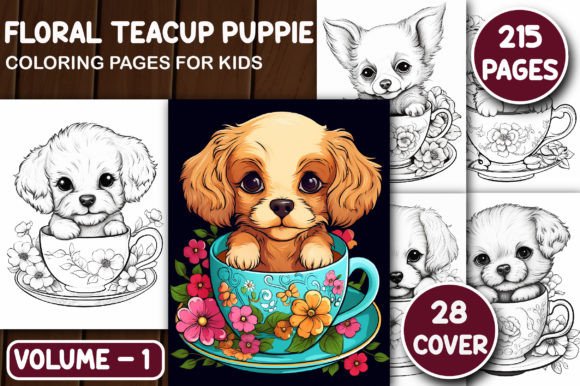
215 Floral Teacup Puppie Coloring Pages
If you're building a digital product line for kids’ creative play—or scaling a KDP coloring book business—the 215 Floral Teacup Puppie Coloring Pages bundle is more than just another collection. It’s a thoughtfully assembled, production-ready asset pack designed for real-world use: 215 distinct interior pages, 28 premium cover options, and full flexibility across print and digital workflows.
Visually, these pages strike a gentle balance between whimsy and refinement. Each illustration features a small dog—often curled, seated, or peeking out—nestled inside or beside an ornate teacup. Delicate floral motifs wrap around handles, spill from saucers, or bloom across backgrounds: roses, daisies, ivy tendrils, and stylized blossoms rendered with soft outlines and open negative space. The line work is consistent at 300 dpi, clean enough for crisp coloring yet expressive enough to feel hand-drawn—not sterile or overly algorithmic. Though AI-generated, the final files were refined in Adobe Illustrator, resulting in smooth curves, intentional spacing, and scalable vector-friendly JPG/PNG assets.
Why This Bundle Fits Real Publishing Workflows
This isn’t a “print-and-pray” download. Every file is pre-optimized for practical output: A4 and US Letter (8.5×11″) sizing ensures compatibility with standard home printers, copy shops, and KDP’s upload system. The 204-page interior PDF is print-ready—no cropping, no margins too tight, no alignment surprises. And because you receive all 215 images as individual JPG and PNG files (plus 28 high-res cover PNGs), you’re free to reorder pages, swap covers, add title pages, insert activity prompts, or build themed volumes—without waiting for a designer.
For entrepreneurs listing on Amazon KDP, Etsy, or your own Shopify store, that level of control matters. You’re not locked into one layout. You can test cover variations, localize titles, add bilingual instructions, or bundle multiple themes (e.g., “Floral Teacup Pupples + Garden Friends”) without reprocessing the core art. That flexibility directly supports A/B testing, seasonal updates, and audience segmentation—key levers for sustainable growth.
Design Integrity Without Compromise
Yes, these are AI-assisted illustrations—but their execution reflects thoughtful post-processing. Lines are uniform in weight, contours avoid jagged artifacts, and key elements (like cup rims or puppy eyes) remain legible even when scaled down to thumbnail size. That consistency supports strong visual hierarchy: the central puppie remains the focal point; florals frame but don’t overwhelm; negative space invites color choice rather than dictating it.
You’ll notice subtle stylistic cohesion across the set—soft curvature, balanced asymmetry, and rhythmic repetition of motifs. That’s not accidental. It creates instant brand recognition across your product line. Whether someone sees your cover on a Pinterest pin, a KDP thumbnail, or a printed display at a local bookstore, the aesthetic reads as intentional, not random. That perception builds trust—especially with parents and educators who scan quickly for quality cues before purchasing.
How to Use These Pages With Purpose
Start by auditing your goals. Are you launching a single bestseller? Then pick 3–5 standout covers from the 28 included, mock them up in context (e.g., on a shelf, as a social ad), and test which generates most clicks. Building a series? Use the consistent linework and motif language to create visual continuity—add custom title fonts, introduce recurring border elements, or layer in your own watermark-style signature.
For readability and engagement, keep text minimal and legible. Pair the playful illustrations with a clean, friendly sans serif (like Poppins or Nunito) for subtitles and instructions—never compete with the art. Avoid script fonts for body text; they reduce scanability for adults selecting books for kids. Save those for decorative accents only.
When preparing for KDP, verify bleed and safety margins manually—even with pre-sized files. Zoom in on corners and edges in your PDF editor. If any floral element grazes the trim line, nudge it inward by 0.125″. Small adjustments like that prevent costly re-uploads and maintain professional polish.
Licensing, Customization & Commercial Reality
You hold full commercial rights. No attribution required. No platform restrictions. You can sell on Amazon, Gumroad, Creative Market, your own site—or even license subsets to schools or therapists. That freedom comes with responsibility: review each image before publishing. While most are polished, AI-generation means occasional quirks—a stray line, a slightly misaligned petal, or inconsistent stroke density in complex clusters. These aren’t flaws that break usability—they’re details you’d naturally adjust in Illustrator if building from scratch. And since you already have editable PNGs and JPGs, light cleanup takes minutes per page.
Think of this bundle as a high-fidelity design scaffold—not a finished product, but a deeply capable foundation. It saves dozens of hours on illustration, gives you immediate visual cohesion, and lets you focus energy where it matters most: positioning, packaging, audience outreach, and iterative improvement.
Who Benefits Most From This Collection?
- KDP publishers launching multiple coloring books per quarter—and needing reliable, on-brand interiors without hiring illustrators each time.
- Educators and therapists creating customized emotional regulation tools, fine-motor worksheets, or classroom calm-down kits.
- Crafters and small studios bundling printable sets for Patreon, Ko-fi, or subscription boxes—with room to add their own branding and extras.
- Bloggers and content creators offering lead magnets, email course bonuses, or Instagram Story templates rooted in cohesive, shareable visuals.
- Print-on-demand designers expanding into kids’ niches with assets that scale cleanly across mugs, tote bags, and wall art—thanks to the 300 dpi PNG transparency support.
The 215 Floral Teacup Puppie Coloring Pages bundle doesn’t ask you to adapt to its limitations. Instead, it meets you where you are—whether you’re refining a single cover in Canva or scripting batch exports in Photoshop—and gives you room to grow, iterate, and own the outcome.