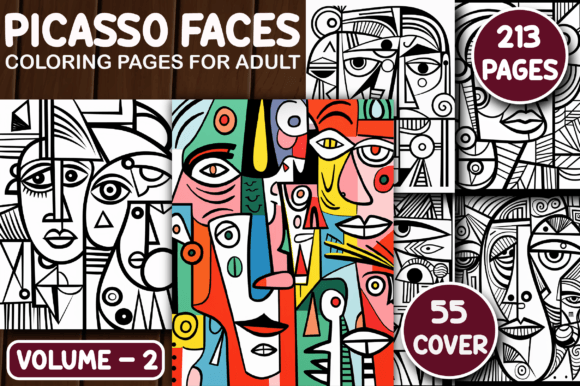
213 Picasso Faces Coloring Pages V - 2
For creators building digital or print-on-demand product lines—especially those targeting adult coloring enthusiasts—the 213 Picasso Faces Coloring Pages V - 2 stands out as a focused, production-ready asset bundle. Unlike generic coloring page collections, this volume centers on stylized, abstracted facial compositions inspired by Pablo Picasso’s cubist language: fragmented profiles, asymmetrical eyes, interlocking planes, and expressive distortions. It’s not an art history lesson disguised as a coloring book—it’s a practical toolkit designed for immediate use in commercial publishing workflows.
A Structured Bundle Built for Real Publishing Needs
The package delivers two core components: 213 interior coloring pages and 55 premium book cover designs—all delivered as high-resolution, print-ready files. Each interior page is formatted to A4 (8.27 × 11.69 inches) and US Letter (8.5 × 11 inches), ensuring compatibility with standard home printers, commercial offset runs, and KDP’s upload requirements. All 213 PDFs are single-page, bleed-free, and optimized for crisp black-and-white line art reproduction. Equally important, the full set is also supplied as individual PNG files at 300 DPI—giving designers flexibility to layer, recolor, or integrate elements into larger layouts without quality loss.
The 55 cover images serve a distinct purpose: they’re not decorative extras but functional variants—different color palettes, typography treatments, and layout configurations—designed to support A/B testing, niche targeting (e.g., “abstract,” “mindful,” “art therapy”), or series expansion. Since each cover is provided as a standalone 300 DPI PNG, resizing within design software like Canva, Adobe InDesign, or Affinity Publisher remains straightforward without pixelation.
AI-Generated, Illustrator-Refined: Quality Context Matters
The listing notes these are AI-generated designs later refined in Adobe Illustrator. That detail matters—not as a disclaimer, but as useful context for expectations. The line work is consistently clean, with appropriate stroke weight and spacing for coloring; there are no stray vectors, overlapping paths, or unintended fills that commonly plague raw AI outputs. That level of post-processing suggests intentional curation, not just automated export. That said, some pages may contain minor inconsistencies—subtle gaps in closed shapes, slight variations in line continuity across similar motifs, or occasional repetition in background patterns. These aren’t dealbreakers for end users, but they’re worth noting if you plan heavy manual editing or require pixel-perfect vector scalability beyond standard printing.
In practice, most users won’t need to open Illustrator at all. The PDFs print cleanly. The PNGs import cleanly into design tools. And the stylistic cohesion across all 213 pages means readers flipping through a finished book won’t encounter jarring shifts in complexity or visual tone—a key factor in perceived quality for adult coloring audiences.
Who Benefits—and How
Self-publishing authors and KDP sellers gain direct value: 213 pages meets and exceeds KDP’s minimum requirement for “book-length” interior content, and the inclusion of multiple cover options streamlines series development. You can launch one title now, then rotate covers or combine subsets (e.g., “Picasso Faces: Cubist Portraits Vol. 1”) later—without sourcing new art.
Freelance designers and marketers can license or resell the bundle as part of client deliverables—say, a wellness brand launching a mindfulness product suite, or an educator developing a visual literacy workshop. The Picasso theme offers built-in recognition and aesthetic appeal without requiring copyright clearance of original artworks.
Educators and therapists working with adults may find the abstraction beneficial: it lowers pressure around “realism,” invites personal interpretation, and supports discussions about perspective, emotion, and perception—without needing formal art training to facilitate.
It’s less suited for users seeking hand-drawn uniqueness or highly detailed illustrative styles (e.g., botanical, mandala, or gothic). This is intentionally stylized, graphic, and conceptual—not ornamental.
Usability in Practice: Workflow Integration and Customization
The file structure supports efficient integration. No ZIP nesting hell—just clearly labeled folders: “Interior_PDF,” “Interior_PNG,” and “Covers_PNG.” Naming conventions follow logical patterns (e.g., “Picasso_Face_042.pdf”), making batch processing or metadata tagging manageable. If you use KDP’s Cover Creator, the PNG covers drop in without scaling issues. If you prefer full control in InDesign, the A4/Letter dimensions align precisely with standard templates.
Customization is viable but bounded. Because the base artwork is raster-based in PNG form (even if vector-derived), extensive reshaping—like stretching a face horizontally by 300%—will degrade edges. However, minor adjustments (cropping, contrast tweaks, overlaying textures or watermarks) work reliably. For deeper adaptation—say, isolating an eye motif to use as a logo element—the included PNGs provide enough resolution to extract clean silhouettes or convert via vector tracing tools.
Realistic Considerations for Long-Term Use
This isn’t a one-time novelty. The 213 Picasso Faces Coloring Pages V - 2 holds long-term utility because its theme is both specific enough to stand out in crowded marketplaces and flexible enough to reinterpret. You can position it as art therapy, creative warm-up, cognitive engagement, or pure aesthetic play—depending on your audience’s framing. There’s no expiration date on cubism as a recognizable visual language.
One limitation worth flagging: while the bundle permits resale and redistribution, it doesn’t include commercial licenses for the underlying AI model output. That’s standard for this category—but it does mean you shouldn’t claim authorship of the original generative process or imply endorsement by Picasso’s estate. Staying factual in marketing copy (“inspired by,” “in the style of,” “cubist-influenced”) avoids ambiguity.
Also, because the pages share a strong stylistic signature, bundling them exclusively with other Picasso-themed assets (e.g., geometric animals or fragmented still lifes) maintains coherence better than mixing them with photorealistic or cartoonish styles. Consistency strengthens perceived value.
Final Assessment: A Reliable Asset, Not a Magic Solution
The 213 Picasso Faces Coloring Pages V - 2 delivers what it promises: a cohesive, technically sound, commercially usable collection of adult coloring content rooted in a distinctive visual vocabulary. Its strength lies in execution—not novelty. It saves time on illustration, reduces risk in KDP formatting, and provides cover options that go beyond placeholder templates. It won’t replace a custom illustrator for a flagship brand project, but it reliably fills a well-defined gap: scalable, stylistically unified, print-ready content for creators who prioritize efficiency without sacrificing recognizability or user experience. For anyone building coloring products with intention—not just volume—it’s a pragmatic, quietly effective resource.