200 Fruit Coloring Pages for Adults KDP
Coloring isn’t just for kids—and it’s far more than a quiet pastime. For creators, educators, marketers, and small business owners, 200 Fruit Coloring Pages for Adults KDP is a ready-to-deploy creative asset with real utility. It’s not a single book or a vague concept—it’s a complete, print-ready interior package built for flexibility, speed, and professional results.
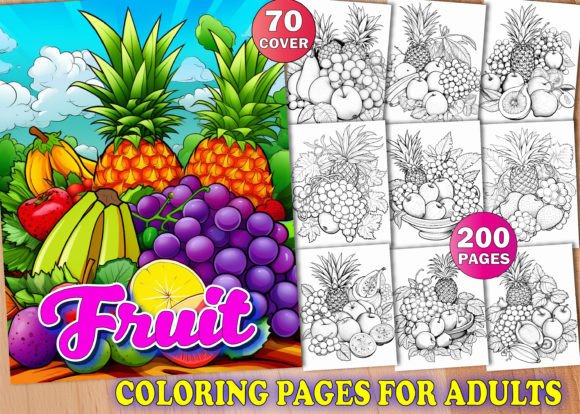
This collection delivers exactly what the title promises: 200 original, high-resolution fruit-themed line art pages—plus 70 bonus coloring images for book covers. Every page is designed at 300 DPI in standard 8.5” x 11” dimensions, optimized for crisp printing and digital clarity. You receive one PDF (print-ready), plus separate folders of 200 JPGs and 200 PNGs—all black-and-white, clean-lined, and free of watermarks or restrictions. That means no waiting, no editing overhead, and no licensing guesswork.
Why Fruit? Why Now?
Fruit themes resonate across audiences—not as clichés, but as accessible, joyful, and universally recognizable symbols of freshness, vitality, and natural beauty. Unlike abstract or seasonal motifs, fruit offers built-in variety: citrus slices with intricate pith textures, tropical fruits with bold silhouettes, berries with clustered detail, and vintage-style orchard illustrations that invite both realism and stylization. This diversity makes the set adaptable—not just for coloring books, but for branding, teaching tools, social media assets, and even product packaging sketches.
More importantly, fruit-based line art avoids cultural or age-specific barriers. A pineapple can be playful for teens, meditative for retirees, educational for classrooms, or on-brand for wellness brands. That versatility is why so many designers and entrepreneurs choose this theme when building scalable creative products.
Creative Applications Beyond the Bookshelf
Think beyond “coloring book.” Here’s how different users are putting 200 Fruit Coloring Pages for Adults KDP to work:
- Self-publishers & KDP sellers: Launch two distinct titles fast—Volume 1 and Volume 2—each with unique cover options drawn from the 70 included cover images. Use the JPG/PNG files to create Amazon thumbnails, Pinterest pins, and email newsletter banners without resizing or quality loss.
- Educators & homeschoolers: Print individual pages for botany units, nutrition lessons, or fine motor skill development. Pair a mango outline with a short paragraph about vitamin C—or use banana sketches to teach symmetry and proportion in art class.
- Freelance designers: Trace or adapt outlines into custom SVG files for cutting machines, turn apple line art into layered embroidery patterns, or overlay fruit silhouettes onto client-branded stationery templates.
- Wellness coaches & therapists: Integrate pages into guided journaling kits—e.g., “Color an orange while listing three things you’re energized by this week.” The consistent 300 DPI ensures clean scans for digital handouts or printable PDF workbooks.
- Small business owners: Repurpose grapevine illustrations as background elements for café menus, juice bar loyalty cards, or farmers’ market signage—no need to license stock art or hire an illustrator.
Styling, Customization, and Consistency
You don’t have to color every page literally. Many users reinterpret the outlines intentionally: turning a pear into a minimalist logo mark, using a watermelon slice as a layout grid for a recipe blog, or converting a kiwi cross-section into a data visualization icon (seeds = data points, rind = boundary). Because all 200 pages share the same resolution, scale, and line weight, mixing styles stays cohesive—even when blending hand-lettered captions, digital shading, or collage elements.
To keep output organized and audience-friendly:
- Group by complexity: Sort pages into beginner (large shapes, low detail), intermediate (textures like strawberry seeds or citrus pith), and advanced (overlapping fruit, vine backgrounds) before assigning to clients or students.
- Maintain file discipline: Rename JPGs and PNGs with descriptive tags—e.g., apple-slice-detail-045.jpg—so you can search and retrieve fast during production.
- Test print first: Even with 300 DPI, paper type affects contrast. Run a test page on your target stock (matte vs. glossy, 60 lb vs. 100 lb) before bulk printing.
- Preserve original integrity: When adapting for logos or icons, simplify—not distort. Crop tightly, retain key identifying features (e.g., the stem on a cherry), and avoid stretching proportions.
Real Projects, Real Results
A freelance educator in Austin used 32 pages from the set to build a downloadable “Fruit & Fiber” nutrition guide for middle schoolers—adding simple callout boxes and fun facts directly over the PNGs in Canva. She sold it as a $7 add-on to her classroom subscription and recouped her KDP investment in under three weeks.
A boutique juice bar in Portland printed 10 favorite pages on recycled cardstock, laminated them, and placed them at tables with colored pencils. Customers stayed 12 minutes longer on average—and shared photos tagged with their location, boosting local SEO and foot traffic.
A blogger focused on mindful productivity repurposed 15 fruit outlines as weekly “focus trackers”: color one segment per completed task. She embedded the PNGs into Notion templates and offered them as a free lead magnet—growing her email list by 21% in one month.
What Makes This More Than Just Another Download
It’s the combination of completeness and control. You’re not buying a promise—you’re getting 200 finished interiors, 70 cover-ready variants, and three interchangeable file formats—no upsells, no hidden fees, no pixelated previews. The black-and-white format gives you full creative authority: ink it, paint it, digitize it, vectorize it, or leave it raw for laser engraving.
And because it’s built for adults—not children—the compositions avoid oversimplification. There’s thoughtful negative space, intentional line variation, and botanical accuracy where it matters (think leaf veining, seed placement, skin texture)—without sacrificing accessibility.
If you’ve ever paused mid-project because you needed one more clean fruit outline—or spent hours searching for royalty-free art that actually prints well—this is the solution that fits seamlessly into your workflow. Not as inspiration alone, but as infrastructure: reliable, reusable, and quietly powerful.