200 Country Cottage Coloring Pages Adult
Coloring isn’t just a pastime—it’s a strategic tool. When thoughtfully selected and applied, coloring pages like 200 Country Cottage Coloring Pages Adult serve as more than decorative assets. They function as tactile, visual scaffolds for focus, brand alignment, creative iteration, and even scalable product development—especially for creators building high-content books on Amazon Kindle Direct Publishing (KDP).
What This Resource Actually Delivers—and Why It Matters Strategically
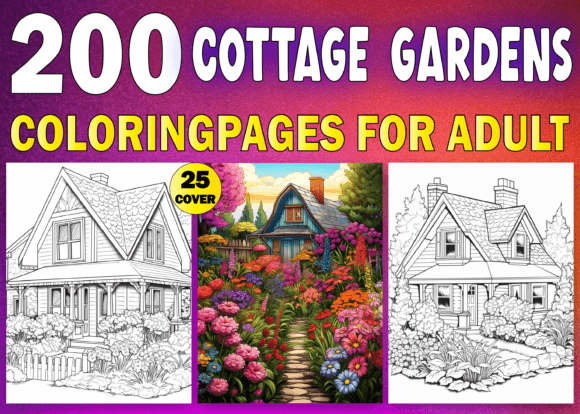
The 200 Country Cottage Coloring Pages Adult collection—and its companion volume, 200 Country Cottage Coloring Pages For Adult Volume – 3—isn’t a generic bundle. It’s a purpose-built, production-ready asset set designed for real-world publishing workflows. You receive a single .zip file containing:
- 200 high-resolution JPG files (300 DPI, A4 / 8.5×11″)
- 200 print-optimized PNG files (300 DPI, transparent or white background options)
- A print-ready PDF with all 200 designs—formatted to fit standard paper without cropping or scaling issues
- 25 professionally styled KDP book cover templates (PNG, 300 DPI), tested for Amazon’s cover preview algorithms and thumbnail readability
This isn’t clipart. These are original, hand-crafted line art illustrations centered around country cottage aesthetics: weathered barn doors, ivy-draped windows, rustic kitchens, floral herb gardens, quilted armchairs, and quiet front porches. Each design balances detail and breathing room—ideal for adult colorists seeking relaxation without frustration.
How to Use 200 Country Cottage Coloring Pages Adult With Intention
Randomly uploading 200 pages to KDP rarely yields strong results. But when aligned with clear goals, this resource becomes leverage. Consider these grounded use cases:
1. Product Positioning in a Saturated Niche
The adult coloring market is competitive—but not uniform. Most titles fall into broad categories: mandalas, animals, florals. 200 Country Cottage Coloring Pages Adult offers thematic cohesion and emotional resonance. “Country cottage” evokes nostalgia, calm, domesticity, and mindful simplicity—distinct from high-energy or mystical themes. That specificity helps you stand out in search and browse, especially when paired with precise backend keywords like “rustic home coloring book,” “cozy cottage adult coloring,” or “farmhouse aesthetic coloring pages.”
2. Iterative Brand Development
If you’re building a series—or multiple KDP brands—this volume supports consistency across titles. Use the included 25 cover templates not as one-off designs, but as a visual system: test color palettes (sage + cream vs. navy + linen), typography pairings, and layout hierarchies. Track which variants generate higher click-through rates in Amazon Ads or early organic impressions. Over time, you’ll learn what resonates with your audience—not through guesswork, but through controlled variation anchored in the same underlying asset set.
3. Operational Efficiency Without Compromising Quality
Creating 200 original, print-ready line drawings from scratch takes hundreds of hours—even for experienced illustrators. Licensing commercial-use art often comes with restrictive terms or recurring fees. With 200 Country Cottage Coloring Pages Adult, you eliminate that bottleneck. Every JPG and PNG is pre-sized, pre-tested, and pre-validated for KDP’s upload requirements. No resizing, no bleed adjustments, no font embedding errors. That means faster time-to-market, lower opportunity cost, and more bandwidth to focus on copywriting, keyword research, or customer engagement.
When to Pause—and Reassess Your Approach
This resource delivers maximum value only when used within a deliberate framework. Here’s what to consider before launching:
- Do you have a defined audience? “Adults who like coloring” is too broad. Are you serving interior design enthusiasts? Retirees seeking low-stimulus hobbies? Therapists recommending grounding activities? Your audience shapes title phrasing, cover tone, and even which 200 pages you select for the final book (e.g., emphasize garden scenes for horticulture-adjacent buyers).
- Is your KDP listing optimized beyond the asset itself? High-quality pages mean little without strong metadata. The PDF interior must include a brief, warm introduction that sets context—not just instructions. Your subtitle should signal benefit (“Relaxing Rustic Scenes for Stress Relief & Mindful Focus”) rather than feature (“200 Coloring Pages”). Backend search terms should reflect how real people search—not industry jargon.
- Are you prepared to support long-term discoverability? One book rarely sustains momentum. Use this volume as a foundation—not an endpoint. Repurpose individual pages into Pinterest pins with descriptive alt text. Turn select scenes into Instagram carousels highlighting “coloring tips for intricate windows” or “how to layer watercolor washes on textured stone walls.” That extends reach beyond Amazon and builds authority.
Risks of Using 200 Country Cottage Coloring Pages Adult Without Strategy
Without intention, even excellent assets can backfire. Common pitfalls include:
- Commoditization: Uploading all 200 pages verbatim into a single title with minimal branding makes your book indistinguishable from dozens of others using similar bundles. Amazon’s algorithm rewards differentiation—not duplication.
- Mismatched positioning: Pairing delicate cottage illustrations with a loud, neon-heavy cover undermines perceived quality. The 25 included covers exist to prevent this—but only if you evaluate them critically against your target reader’s expectations.
- Missed cross-sell potential: This volume works best as part of a system. For example, pair it with a companion journal (“Country Cottage Reflection Pages”) or a short guide (“5-Minute Coloring Rituals for Busy Professionals”). Without planning those extensions, you leave revenue—and reader loyalty—on the table.
Practical Planning Tips for Launch Success
Here’s how seasoned KDP creators structure their rollout:
- Select intentionally: Don’t default to “all 200.” Choose 40–60 pages that share a subtle narrative thread—e.g., “Cottage Morning Rituals” (kettle, bread loaf, sunlit window seat) or “Garden Seasons” (spring seedlings, summer roses, autumn pumpkins). Thematic grouping increases perceived value and encourages repeat purchases.
- Test cover variants early: Upload 3–5 of the included 25 covers to KDP Draft mode. Let them sit for 48 hours, then check how they render in Amazon’s mobile preview. Does text remain legible at thumbnail size? Does the mood match your intended reader?
- Add micro-value in the interior: Insert two blank pages after every 10–15 coloring pages. Label them “My Color Palette Notes” or “This Scene Reminds Me Of…” That small addition transforms a coloring book into a light interactive journal—increasing dwell time and perceived utility.
- Build backend keywords around outcomes: Instead of “cottage coloring,” prioritize phrases like “anxiety relief coloring book,” “mindful coloring for adults,” or “screen-free relaxation activity.” Those reflect user intent—not just subject matter.
Long-Term Value Beyond the First Book
200 Country Cottage Coloring Pages Adult isn’t a one-time purchase—it’s infrastructure. Once you’ve validated demand for this aesthetic, you can:
- Create seasonal spin-offs (e.g., “Country Cottage Winter Evenings”) using unused pages from the bundle
- Develop companion workbooks (“Design Your Dream Cottage: Sketch + Plan Pages”)
- Leverage the PNG files for merch—tote bags, greeting cards, or printable wall art—with zero additional illustration cost
- License select designs to educators for classroom mindfulness breaks (with appropriate usage review)
The real advantage lies in repeatability. Because every file is 300 DPI and A4/8.5×11″ native, there’s no degradation when repurposing across formats. What starts as a KDP coloring book can evolve into a small ecosystem—rooted in consistent, high-fidelity visuals.
Final Thought: Tools Enable Decisions—They Don’t Replace Them
200 Country Cottage Coloring Pages Adult gives you speed, quality, and flexibility. But it doesn’t decide who your reader is, what problem your book solves, or how you’ll earn trust over time. Those choices still belong to you—and they’re where real differentiation happens. Use the files with clarity, not convenience. Align each page, cover, and description with a specific outcome. Then measure, refine, and scale—not just the product, but the thinking behind it.