200 African Black Woman Coloring Pages: A Practical Evaluation for Creators and Educators
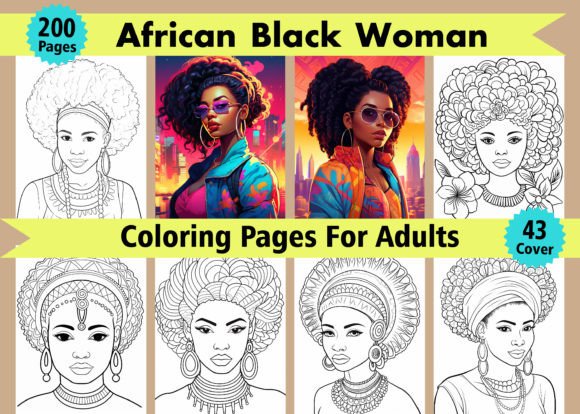
For artists, educators, therapists, and self-publishers seeking culturally affirming, high-resolution coloring content, 200 African Black Woman Coloring Pages represents a focused, production-ready resource. Unlike generic adult coloring collections, this set centers Black women’s representation across diverse ages, hairstyles, attire, expressions, and cultural contexts — from contemporary urban scenes to traditional West African motifs, Afrofuturist silhouettes, and everyday moments of rest and resilience. The collection is structured as two complementary volumes: one optimized for general use and another explicitly tailored for adults, with intentional design considerations for fine motor engagement, visual complexity, and thematic depth.
What Makes This Set Distinct Beyond Representation
Representation matters — but execution determines usability. 200 African Black Woman Coloring Pages distinguishes itself through technical consistency and format flexibility. Each illustration is delivered in three native formats: JPG (300 DPI), PNG (300 DPI with transparent backgrounds), and PDF (300 DPI, 8.5″ × 11″). This isn’t just convenience — it directly impacts workflow efficiency. PNG files support layer-based editing in tools like Photoshop or Procreate; JPGs suit quick digital previews or web use; PDFs preserve vector-like crispness for print-on-demand platforms like KDP. The inclusion of 43 additional PNGs for book covers further signals attention to publishing realities — no need to resize or reformat cover art separately.
The four-folder organization reflects practical user segmentation: one for JPGs, one for PNGs, one for PDFs, and one for cover assets. This avoids the common friction of unzipping a single folder with mixed file types and inconsistent naming. For someone preparing a KDP upload, having all 200 pages pre-sized to standard US letter dimensions eliminates scaling errors, bleed adjustments, or DPI-related blurriness — issues that routinely delay approval or compromise print quality.
How It Compares With Broader Coloring Page Options
General adult coloring books often prioritize ornamental density over narrative or identity resonance. While intricate mandalas or botanical themes offer relaxation benefits, they rarely provide opportunities for personal or cultural reflection. In contrast, 200 African Black Woman Coloring Pages integrates symbolic elements — headwraps with Adinkra-inspired patterns, braided hairstyles rendered with anatomical accuracy, figures holding books or musical instruments — without sacrificing artistic clarity. These aren’t caricatures or stylized abstractions; they’re grounded, respectful depictions intended for coloring, not just viewing.
Compared to free online resources or low-cost bundles, this set trades breadth for fidelity. Many free downloads are 72–150 DPI, lack consistent sizing, or contain watermarks, making them unsuitable for commercial reuse. Here, every file meets professional printing standards — a non-negotiable for creators selling physical products or licensing digital assets. That said, if your goal is rapid prototyping or classroom handouts where resolution isn’t critical, lower-DPI alternatives may suffice — and cost less.
Strengths and Real-World Fit
The primary strength of 200 African Black Woman Coloring Pages lies in its readiness for direct application. Therapists using art-based interventions can select pages aligned with client identity without needing to edit or trace existing images. Educators building social-emotional learning units around self-concept, heritage, or media literacy have immediately usable visuals. Self-publishers targeting niche audiences on Amazon or Etsy gain a complete interior file set — no assembly required.
Consider two scenarios:
- A counselor developing a group curriculum on racial identity development chooses five pages showing Black women at different life stages — a teen studying, an elder telling stories, a mother and child, a dancer mid-movement, and a scientist in a lab. Each image invites discussion about roles, aspirations, and societal perception — and each prints cleanly at full size.
- An indie publisher launching a “Black Joy Journal” uses 195 interior pages from the set, adds five original quote pages, and applies one of the included cover PNGs. The entire KDP interior uploads in under 10 minutes, with zero formatting surprises.
In both cases, time saved on sourcing, editing, and troubleshooting translates into deeper focus on purpose — whether therapeutic, pedagogical, or entrepreneurial.
Tradeoffs and Limitations to Acknowledge
No resource fits every need — and transparency supports better decisions. 200 African Black Woman Coloring Pages does not include editable source files (e.g., SVG or layered PSD), so users who require custom modifications — such as changing poses, adding text, or integrating brand colors — will need intermediate design skills and compatible software. Similarly, while the themes are intentionally varied, the collection doesn’t extend into highly specialized subgenres like historical portraiture (e.g., Nzinga of Ndongo) or disability-inclusive representation beyond implied accessibility in posture and activity. These aren’t oversights — they reflect scope boundaries, not omissions.
Another consideration: the set assumes familiarity with basic digital file management. Users new to KDP or print workflows may benefit from supplemental guidance on PDF export settings or PNG transparency handling — though the provided files themselves require no technical intervention to use.
When This May Be the Right Choice — and When It Might Not Be
This collection is especially well-suited when:
- You need a commercially safe, ready-to-upload interior for a KDP coloring book — particularly one centered on Black womanhood.
- Your work prioritizes cultural specificity and avoids generic or stereotyped imagery.
- You value cross-format consistency (JPG + PNG + PDF) for flexibility across digital and print outputs.
- You’re working under tight deadlines and cannot afford delays from file rejection, rescaling, or DPI corrections.
It may be less ideal if:
- You require customizable vector assets for scalable signage, apparel, or web graphics.
- Your audience spans multiple global paper standards (e.g., A4 only) and you lack tools to batch-resize without quality loss.
- You’re seeking interactive or animated coloring experiences — this is strictly static, printable/digital colorable art.
- Your project demands licensed rights beyond standard commercial use (e.g., merchandising on mugs or t-shirts), which would require separate permission review.
Making a Grounded Decision
Evaluating 200 African Black Woman Coloring Pages isn’t about finding the “best” coloring resource overall — it’s about matching capabilities to intent. If your goal is to create something meaningful, efficient, and technically sound — whether for healing, teaching, publishing, or personal practice — this set delivers measurable advantages in consistency, cultural alignment, and production readiness. Its value emerges not in isolation, but in how seamlessly it integrates into real-world workflows.
Compare it against your actual constraints: time, technical access, distribution channels, audience expectations, and desired outcomes. If those align with what this collection offers — 200 high-fidelity, thoughtfully composed, commercially usable pages — then it earns serious consideration. If your needs sit outside that scope, that’s equally valid. The most effective creative and educational work begins not with the flashiest tool, but with the clearest understanding of what the work actually requires.