180 Flower Coloring Pages for Adults KDP
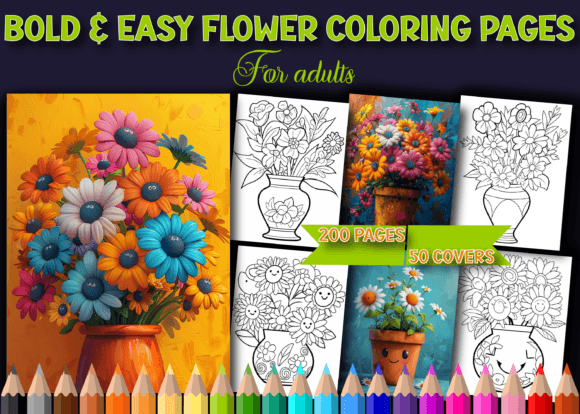
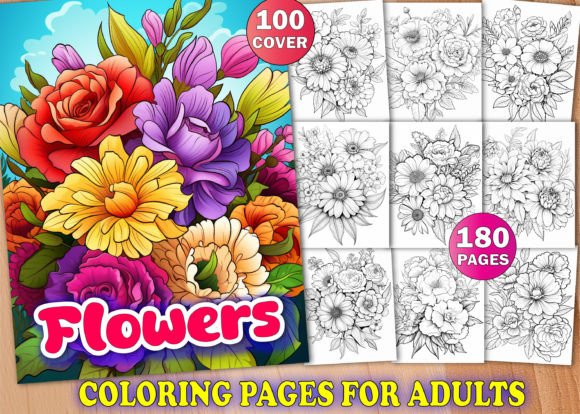
For creators building coloring books for Amazon KDP—or expanding an existing catalog—the 180 Flower Coloring Pages for Adults KDP is more than a design bundle. It’s a production-ready asset that fits cleanly into multiple phases of the publishing workflow: ideation, asset assembly, formatting, branding, and even post-launch repurposing. Its structure—180 original black-and-white floral illustrations, delivered in high-resolution PDF, JPG, and PNG formats—means it doesn’t require redesign or cleanup before use. That saves time, reduces friction, and increases consistency across volumes.
How It Fits Into Your Publishing Workflow
If you’re launching your first KDP coloring book or scaling a series, timing matters. You don’t want to wait for illustrations while copy is finalized or covers are mocked up. With 180 Flower Coloring Pages for Adults KDP, the interior assets are ready the moment you decide to move forward. No illustrator onboarding, no revision cycles, no licensing checks. Just download, verify resolution (300 DPI), confirm dimensions (8.5” × 11”), and begin assembling your print-ready file.
This changes how you allocate effort. Instead of spending 2–3 weeks sourcing or commissioning line art, you shift focus to higher-leverage tasks: refining your title and subtitle strategy, testing cover variations, writing compelling back-cover copy, or planning your launch sequence. The bundle includes free 100 book cover images, so even visual branding can progress in parallel with interior prep—no need to pause for custom cover design unless you choose to.
Volume Integration: Why “Volume – 3” Matters Strategically
The inclusion of 180 Flower Coloring Pages for Adults Volume – 3 signals continuity—not repetition. If you’ve already published Volumes 1 and 2, this set provides thematic cohesion without visual overlap. Each volume maintains a distinct floral motif language: one may emphasize botanical realism, another stylized symmetry, and Volume – 3 leans into intricate layering and negative-space interplay. That variation supports organic series growth—readers who enjoy one volume are likely to explore others, and Amazon’s algorithm rewards consistent, thematically linked releases.
From a production standpoint, using Volume – 3 alongside earlier volumes means you can standardize metadata, interior templates, and marketing assets. Page count stays uniform (180 pages), trim size remains identical (8.5” × 11”), and resolution is consistent across all files (300 DPI). That uniformity simplifies bulk-uploading to KDP, speeds up proofing, and improves buyer trust—readers know exactly what to expect in terms of quality and layout.
File Format Flexibility Enables Real-World Use Cases
The delivery includes three file types—PDF, JPG, and PNG—each serving a specific role in your process:
- PDF (print-ready): Use this as your master interior file. It’s pre-formatted for KDP’s print specifications—no margins to adjust, no bleed concerns, no font embedding issues. Upload directly after adding your title page and copyright notice.
- JPG (300 DPI): Ideal for creating social media teasers, Pinterest pins, or email newsletter previews. High-res JPGs render crisply on screens and retain detail when zoomed—critical for showcasing fine linework in floral designs.
- PNG (300 DPI, transparent background): Lets you composite individual pages over branded backgrounds, add subtle watermarks, or build animated flip-through demos. Useful for educators demonstrating usage in workshops or freelancers showing clients how pages integrate into larger course materials.
This format diversity means you’re not locked into one output path. Need to convert pages into a digital workbook? PNGs let you layer text instructions or answer keys. Planning a print-on-demand side product like greeting cards or wall art? JPGs export cleanly to Canva or Adobe Express. The files adapt to your goals—not the other way around.
Quality Control Starts With Consistency
Every page in 180 Flower Coloring Pages for Adults KDP meets the same technical standard: true black-and-white (no grayscale noise), vector-clean linework, and balanced density—neither too sparse nor overwhelmingly dense. That consistency eliminates manual QA steps like adjusting contrast per page or fixing stray pixels. You can run a quick spot-check on the first 10 and last 10 pages, then confidently batch-process the rest.
It also supports long-term usability. If you plan to release seasonal editions (e.g., “Spring Blooms” or “Botanical Garden Collection”), having a baseline set of 180 reliable pages lets you mix and match—pull 40 pages from Volume – 3, 40 from Volume 1, and 40 newly commissioned pieces—without disrupting visual rhythm. That kind of modular flexibility only works when source assets share core technical and stylistic properties.
Integration With Other Tools and Platforms
This bundle doesn’t exist in isolation. It works alongside tools you’re already using:
- KDP Dashboard: Since all files meet KDP’s print requirements, uploading takes under five minutes. No reformatting, no rejection loops.
- Canva or Affinity Publisher: Drop in JPG or PNG files to build promo graphics, sales pages, or printable instruction guides.
- Mailchimp or ConvertKit: Use individual flower pages as lead magnets—offer “5 Free Floral Pages” in exchange for email signups, then follow up with Volume – 3 as a paid upsell.
- Teachable or Thinkific: Embed pages into lessons on mindful drawing, botanical illustration basics, or stress-reduction techniques—PNG transparency allows clean overlays with instructional text.
You don’t need new software or subscriptions to leverage the bundle. It’s built to slot into your existing stack—no learning curve, no compatibility gaps.
Practical Implementation Tips for Creators
Here’s how experienced publishers actually use this resource:
- Batch-create variants: Duplicate the PDF, replace the cover, change the title, and publish as “Floral Mandalas,” “Garden Therapy,” or “Botanical Line Art”—all using the same 180 pages. Test which titles resonate before investing in new illustrations.
- Repurpose for non-book products: Print select pages on premium cardstock for art therapy kits, or license subsets to subscription box curators looking for exclusive coloring content.
- Use cover images strategically: Of the 100 free cover images, pick 3–5 with strong color contrast and clear typography space. A/B test them in Amazon ads before finalizing your main listing.
- Organize by complexity: Sort the 180 pages into beginner/intermediate/advanced folders. That makes it easy to build tiered workbooks—or create YouTube tutorials that scaffold skill progression.
None of these approaches require altering the original files. They rely instead on thoughtful organization, selective use, and alignment with audience needs—not just volume.
Moving Beyond the First Launch
Once Volume – 3 is live, the real workflow advantage emerges. You now have a verified, high-performing interior template. Future volumes become faster to produce—not because you’re reusing the same pages, but because you understand how they behave in KDP’s system, how readers engage with them, and how best to position them. That knowledge compounds. You’ll know which floral motifs drive higher engagement in thumbnails, which page ranges get shared most on Instagram, and how much time readers typically spend per session (based on analytics from earlier volumes).
That insight feeds back into planning—not just for coloring books, but for complementary offerings: printable planners with floral headers, guided journal prompts themed around growth and renewal, or even short audio meditations paired with specific pages. The 180 Flower Coloring Pages for Adults KDP isn’t a static product. It’s infrastructure—designed to support iteration, extension, and sustainable creative output.